Jonah
Grace
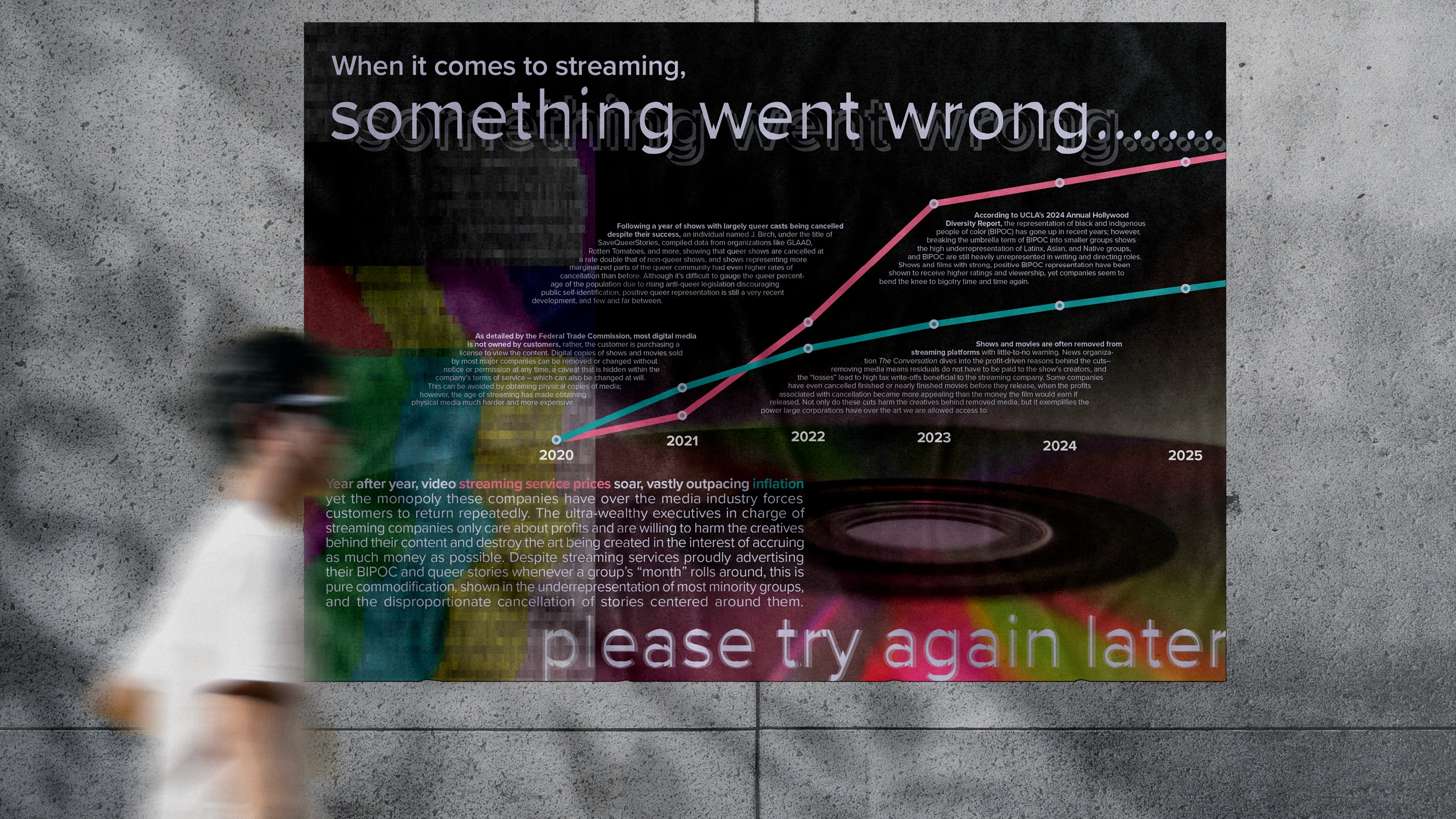
Streaming Services Informational Poster
About Project
An informational poster focusing on an invention with a consequential impact on society, streaming services. Educates the audience on a variety of issues with streaming services, such as subscription price hikes, poor representation, and media disappearing from platforms. Although the poster is aimed at a wide audience – anyone who utilizes streaming services – it focuses on those who care about fairness and equity, highlighting the various ways streaming companies take advantage of and harm their employees and customers.
Progress
Since the draw to my choice came from my own dissatisfaction with streaming services, I began my process of compiling information by listing some of my own grievances – the ever-rising subscription prices, harsh anti-password sharing measures, removal of media, et cetera. I also wanted to focus on the diversity, of lack thereof, shown on our screens, as streaming has established enough of a monopoly over the TV and movie industry to be largely representative of mass media in its entirety. In terms of diversity, I investigated sources such as the UCLA’s yearly “Hollywood Diversity Report”, GLAAD’s “Where We Are on TV” report, and research compiled by SaveQueerStories on queer representation statistics from Rotten Tomatoes, Vulture, et cetera. On the money side of things, I pulled current and previous subscription prices for various streaming services directly from their websites, calculated their average annual increase, and compared it to yearly inflation rates pulled from U.S. Labor Department data.
Although I kept my overall concept, I homed in much more throughout the process, such as moving from a more general theme of capitalism’s commodification of minority experiences to talking about specific statistics on representation in media. Since my initial draw towards streaming came from my frustration with the rising prices compared to diminishing product, my poster tackled the question of what we, as consumers, are paying for. Due to streaming’s monopoly over the TV and movie industry, I defined the limits of my system as the industry as a whole, with my invention having a place within that system and sharing many of its attributes. People affected by the issues my poster references is quite a wide audience; within that, my poster is meant to appeal to those who care about fairness and equity – not only in terms of representation, but in terms of how these companies take advantage of both their employees and customers. I directed attention towards issues that apply to all subscribers, especially those that provoke a feeling of unfairness or violation. My poster is meant to appeal to the public, so I tried to keep my facts concise and avoided any confusing wording and tangents.
The techniques I used from Graphic Design Thinking in my design process include brainstorming, mind mapping, visual research, brand languages, creative briefs, kit of parts, and physical thinking. Throughout our time spent on the project we had multiple group brainstorming sessions in class, and it was incredibly helpful to hear others’ ideas, as well as to gauge the understandability of my poster. Mind mapping was also used throughout the early stages, first in our jeans-based exercise, then two mind maps to flesh out our initial ideas, as well as a group mind-mapping activity. As a group we used visual research through an expedition to the campus library where we found and examined informational graphics from other designers; additionally, I researched the visual brand language used by various streaming services, such as Netflix, when creating the visual aesthetic for my poster. A creative brief came from the assignment sheet given to us when the project began, with our professor acting as a “client” of sorts; this was individually refined as we each figured out the specific goals we wanted to achieve in our posters, with input from both professor and peers. The kit of parts and physical thinking techniques came into play when we were assigned to compile and bring in a variety of objects that had interesting properties of texture and transparency, and then were given time to experiment with the objects and their interactions with light and with each other; in fact, one of the photographs I took as part of this exercise made it into my final poster.
From the beginning of the project one of my concepts was to incorporate a DVD – a remnant of a nearly bygone era of physical media that the age of streaming has put an end to. Once I had my photograph and body copy, I focused on creating and refining the poster in a way that would echo the sleek, professional brand language used by streaming services, with a sense of “wrongness” coming from the glitched text and error screen overlay. All of the larger aesthetic choices I made were successful in their reception, and the choices I made that didn’t work were smaller things; for example, I had to adjust the font sizes in order to achieve the best readability in the large-scale poster, and the text shape and flow of the body copy had to be changed a couple times before I reached a satisfactory result. This was my first time incorporating a large amount of text into a poster, as well as my first time working with uniquely shaped text boxes, so I learned a lot about how to use both effectively, thus helping me achieve my final poster.
In the creation of my poster, I used the design elements of color, line, space, shape, and, form, and the principles of contrast, balance, white space, hierarchy, movement, similarity, closure, and common fate. Throughout my poster I use an array of vibrant colors from my DVD photograph, which join with a dark background to create a high degree of contrast, as well as tying to the current streaming aesthetic of bold colors on dark backgrounds. Aesthetically speaking, I also chose the typeface Proxima Nova as modern sans-serif typefaces are used by the majority of services. Line is used most clearly in the large line graphs showing the increase in subscription prices, which also help create a sense of movement for the viewer as they move through the informational text. Although my poster has a lot of text, there’s “blank” space throughout where the only visual is the background photography, functioning as a white space and helping with the overall balance. The form of the DVD in the photograph is used to create a border for the dates to sit on and the line graphs to come out of. Hierarchy is used to lead the viewer’s eye throughout the poster, as the eye is caught by the large DVD and title, then drawn to the summary in a smaller font, leading to the line graphs visualizing the data brought up in the summary, with the smallest aspects being more specific details, which the viewer can skip over while still understanding the overall argument. The Gestalt principle of similarity helps inform the viewer of what the line graph represents without traditional labeling, as each variable listed in the summary – prices and inflation – is the same color as its respective line. Also relating to the line graph, the principle of closure helps the viewer correlate the points of data to the year by creating an imaginary line between them. Finally, the lines of the graph go off the poster’s edge, which, tied to the principle of common fate, communicates that these price trends will continue worsening as time progresses.
As stated, my solution is intended to mimic the sleek, professional, corporate aesthetic of streaming service UI and visual identity, but with a degree of disorder meant to show how the age of streaming has gone “wrong”. Emotionally, my body copy appeals to pathos by evoking a feeling of righteous indignation at these corporations’ unfair practices, supported by logos through citations and statistics throughout. The viewer should come away from the poster feeling both informed and indignant. I feel my poster is very successful; in fact, this is the most satisfied I’ve been with one of my posters throughout my college career thus far. Starting off with a strong image and concept allowed me to spend most of the time doing smaller changes that I typically would have run out of time to do before the due date. Starting over I don’t think I would have done anything differently except to make sure I was incorporating an information graphic from the get-go; however, that was easy enough to add in after that correction.
My poster uses all three types of semiotic signs covered in Visual Signs, icon, index, and symbol. The image of the DVD is of course iconic of physical media as it exists, as well as being indexical of movies and TV within the poster’s context; further, it becomes symbolic of the age of physical media that streaming has left behind, assisted by its place at the beginning of the line graph showing prices throughout time. The TV error screen overlay is iconic of an issue with television, and indexical of television and a problem in general; similarly, the glitching text is indexical of something going wrong. The use of Proxima Nova and “something went wrong”, a classic error message used by Netflix and other digital services, are symbolic of digital corporate identity. Netflix also uses a static TV screen as a visual representation of an error encountered, so my use of a glitching screen becomes symbolic of an issue with a streaming service. The seemingly haphazard arrangement of text blocks, which create a horizontal line texture from afar or out of focus, also tie together symbolically with the glitching aesthetic. Finally, the line graph is both indexical of statistics, insinuating my poster’s message is based in evidence, and symbolic of an inequality issue, as one line stays steady whilst the other rises chaotically.